
Trauma
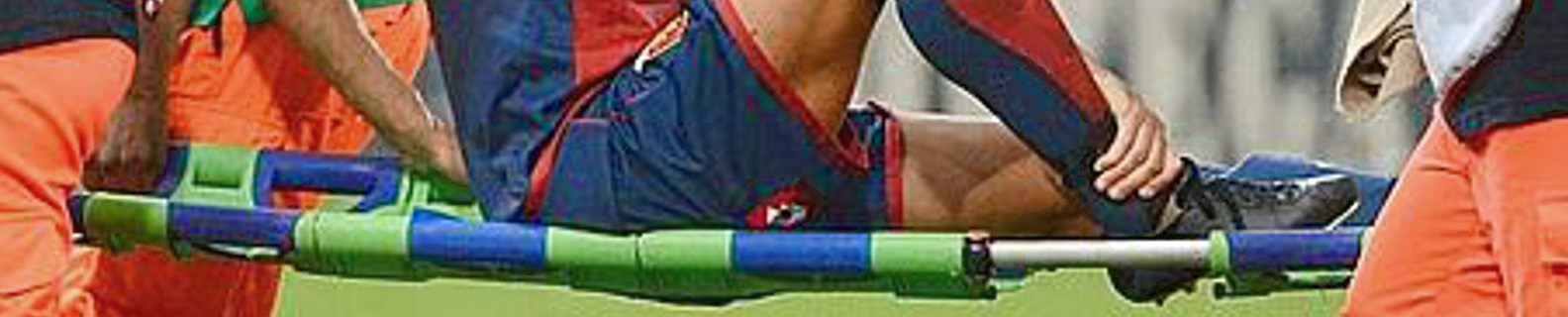
A trauma is any injury caused by a mechanical action. It occurs when the body (tissue) collides with another resisting body. The narrower the surface exposed to the blunt force, the more serious the consenquences. Let’s take a look at the most serious sport-related traumatic injuries.
- Concussion: it is a deceleration causing a partial or total suspension of the affected organ activities, for example after an impact against an obstacle. The concussion is manifested by loss of consciousness, amnesia, dilated pupils. The spinal concussion is manifested by mental disorders, pain along the spine and paralysis. You have to call 118, to put cold compresses on the injured person’s head and not to move him/her at all.
- Contracture: it is caused by an inadequate warm up or by overtiredness. It occurs 8-24 hours after the effort and it is manifested by the feeling that the muscle is not allowing full elongation. It is necessary to interrupt the physical activity and to abstain from efforts for 2-5 days. It is helpful to stretch and to gradually resume physical activity, but it is important to avoid massages.
- Contusion: it is an injury to the bones, soft tissue or muscle groups of the body that is manifested by bruising and swelling of the affected area. It is necessary to apply ice and to compress the injured area with elastic bandages, keeping the affected part at rest and to apply ointments that help to reabsorb bruises or hematoma. Do not rub or apply heat to the affected area.
- Cramp: it is a very painful and involuntary contraction of a muscle that is manifested by a hardened, aching and contract muscle. It is necessary to cautiously stretch the muscle without jerking.
- Sprain: a sprain occurs when a joint undergoes an abnormal movement, without losing contact with its articular heads. It is manifested by painful and swollen articulation and little or no ability to move. It is necessary to keep the affected area at rest, to apply ice, o compress the injured area with elastic bandages and to keep it fully extended. Do not rub or apply heat to the affected area, nor hastily resuming physical activity.
- Haemorrhage: a haemorrhage (or bleeding) is a leakage of blood from the vessels. Arterial bleeding is manifested by bright red blood spurting out in rhythm. Venous bleeding is manifested by dark red blood flowing in a steady stream. If the haemorrhage is of unknown cause, it is necessary to compress the wound. In case of arterial bleeding, it is necessary to compress between the heart and the wound. In case of venous bleeding, it is necessary to compress the wound. Nosebleed may be a result of traumatic injuries, hypertension, colds, changes in atmospheric pressure and energetic nose blowing. Nosebleed is treated leaning upper body and head slightly forward. Then it is necessary to pinch nostrils just below the nasal bones with thumb and forefinger for 10 minutes. Do not tilt your head back. This may cause blood to run down the back of your throat.
- Excoriation/wound/cutting: it is an injury of the superficial layers of the skin (excoriation), or an opening of any part of the body including internal organs in the most serious cases. It is manifested by bleeding, broken skin and pain. It is necessary to clean the wound and the surrounding area with soap and water, in order to remove all the dirt. Then, it is necessary to disinfect the part with an antiseptic solution from the centre to the periphery of the wound and to cover it with a sterile dressing or patch. Anti-tetanus serum injections are recommended. It is important not to touch the wound with unwashed hands.
- Blister: it is caused by repeated rubbing and it is manifested by aqueous fluid-filled blisters and pain. After a blister breaks, it is necessary to clean it with soap and water, to disinfect with tincture of iodine and 70% alcohol and protect the part with gauze and/or patches. Always protect those parts that are exposed to rubbing when doing sports.
- Fracture: it occurs when the flexibility and resilience of a bone collapse due to the violent action of a direct or indirect force. It is manifested by swelling, severe pain, inability to move and deformation of the fractured segment. It is necessary to keep the injured person at rest, avoiding any movement of the fractured part, and to call 118.
- Dislocation: it occurs when a bone slips out of a joint with the permanent loss of contact between the articular surfaces. It is manifested by swelling, pain, deformation and inability to move the joint. It is necessary to keep the affected part at rest and to call an ambulance. Do not massage, nor to force the joint back into place.
- Osgood-schlatter disease: it is an inflammation of a small bony bump on the front upper part of the tibia due to hamstring strain during growth age (boys 10-15 years, girls 8-13 years). It is manifested by pain, swelling, and inability to perform physical activity. It is necessary to apply ice, anti-inflammatory patches, ointments and pain medications. It is recommended to rest in the acute phase.
- Sprain: it is an injury to a muscle as a result of an incorrect movement. It is manifested by sudden and sharp pain, which follows the muscle spasm. It is important to immobilize the injured person, to apply ice to the affected area, and to wait 10-20 days before resuming sports activities.
- Strain: it is a lesion of the muscle occurring as a result of an excessive muscular tension, usually in the legs. It can be caused by fatigue, moisture, cold and lack of training. It is manifested by sudden pain during physical activity that prevents from continuing the action. It can be noticed a slight deformation of the affected area due to the shrink of broken fibres. It is necessary to raise the affected limb higher than the body, to wrap it with elastic bandages and to apply ice to it. It is important to rest 30-60 days before starting a gradual rehabilitation therapy. Do not massage the muscle.
- Fainting: it is caused by reduced blood flow to the brain due to hot environment, to being standing for too long, to severe pain or too intense emotions. It is manifested by pallor, sweating, dizziness, blurred vision, gradual loss of consciousness and fall. It is necessary to lay the injured person, to loosen up his/her clothes and lift his/her legs up high. Do not give alcohol to the injured person, do not slap his/her face, nor try to put him/her back on his/her feet.
- Tendinitis: it is an inflammation or rupture of a tendon caused by a repeated micro trauma and overfatigue. It is manifested by severe pain during movement. It is necessary to rest for 30-60 days, to treat with ultrasound and electrotherapy, to take anti-inflammatory drugs. If Achilles inflammation tendon occurs, it is necessary to use a heel lift.
- Ocular trauma: an ocular trauma may occur as a result of a punch, or of accidental clashes and it is manifested by blood leakage from the tissues. It is necessary to apply ice and to compare sight in the injured eye to the uninjured eye: if the vision seems to be slightly hazy and doubled, it is necessary to seek the ophthalmologist’s care. In case of contact with chemicals, wash the eye well with running water. In the presence of the a foreign body, it is necessary to put the bandage on the eye and to call 118.

