
Table tennis (ping-pong)
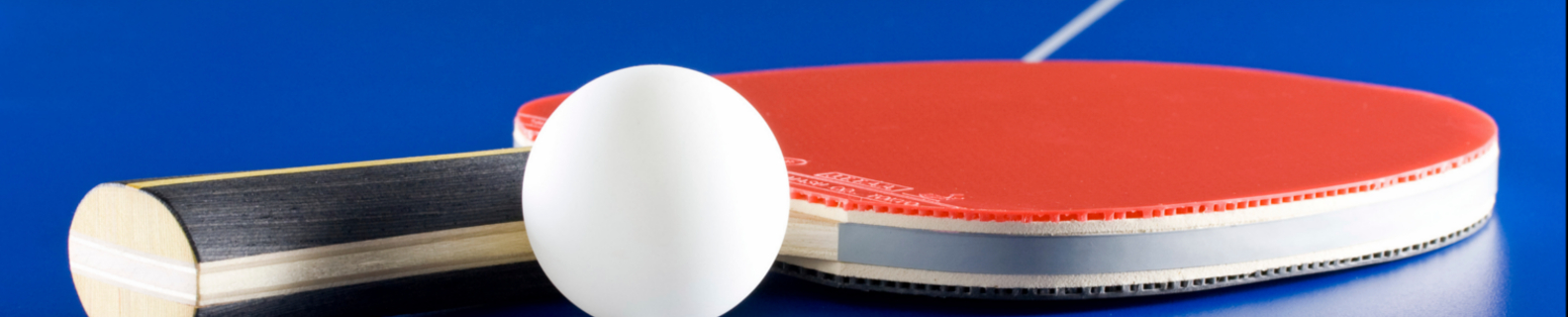
Table tennis, or ping-pong, is a racket sport in which two or four players hit a lightweight celluloid ball back and forth across a table (2.74 m long, 1.525 m wide, and 76 cm high) using a small, round bat. The table yields a uniform bounce of about 23 cm when a standard ball is dropped onto it from a height of 30 cm. The table is divided into two halves by a net at 15.25 cm in height. The purpose of the game is return the ball in the opposing half, after it has bounced on one’s own side. Points are scored when a player fails to return the ball, on the contrary points are lost when a player fails to comply with the game rules or when he/she makes a mistake. A game shall be won by the player or pair first scoring 11 points, unless both players and pairs score 10 points, when the game shall be won by the first player or pair subsequently gaining a lead of 2 points. A match shall consist of the best of 3 or 5 of games. The right to choose the initial order of serving shall be decided by lot and the winner may choose to serve or to receive first or to start at a particular end.

Valid serve: at the start of the game, the ball shall be resting freely on the open palm of the server’s stationary free hand, above the level of the playing surface and behind the server’s end line. The server shall then project the ball near vertically upwards, so that it rises at least 16 cm after leaving the palm of the free hand As the ball is falling the server shall strike it so that it touches first his/her court and then touches directly the receiver’s court. In doubles, the ball shall touch successively the right half court of server and receiver. The ball shall not be hidden from the receiver by the server or his/her doubles partner. As soon as the ball has been projected, the server’s free arm shall be removed from the space between the ball and the net.
Order of serving: each player serves two in a row alternately. In doubles, after each 2 points have been scored the serving pair shall become the receiving pair. A point is scored if an opponent fails to make a correct service.
Valid return: the ball shall be struck so that it touches the opponent’s court, either directly or after touching the net assembly.

Order of serving and receiving in doubles: in each game of a doubles match, the pair having the right to serve first shall choose which of them will do so and in the first game of a match the receiving pair shall decide which of them will receive first. In subsequent games of the match, the first server having been chosen, the first receiver shall be the player who served to him or her in the preceding game. At each change of service the previous receiver shall become the server and the partner of the previous server shall become the receiver.
The expedite system: the expedite system shall come into operation after 10 minutes’ play in a game or at any time when requested by both players and pairs. If the ball is in play when the time limit is reached, play shall be interrupted by the umpire and shall resume with service by the player who served in the rally that was interrupted. If the ball is not in play when the expedite system comes into operation, play shall resume with service by the player who received in the immediately preceding rally. Each player shall serve for 1 point in turn until the end of the game, and if the receiving player or pair makes 13 correct returns in a rally the receiver shall score a point. The expedite system shall remain in operation until the end of the match.

The grip of the racket shall allow wrist mobility.
- Shakehand grip: the racket is held between the thumb and index finger while the other fingers wrap around the handle.
- Penhold grip: forefinger and thumb grip the handle, while the other fingers are on the opposite side of the racket.
In the service, the server shall project the ball near vertically upwards, as he/she can impart higher speed by throwing the ball very high. There are different types of table tennis serves.
- Cut: the ball is struck on its lower side.
- No-spin: the player hits the ball flat.
- Top-spin: the ball is hit on the side with a movement from bottom upwards; it produces different and unpredictable trajectories.
Topspin is produced by starting the stroke below the ball and brushing the racket against the ball in an upward and forward motion. The forward spin increases the downward pressure on the ball, so after it bounces on the table it will stay low and accelerate forward. When a topspin stroke makes contact with the opponent’s racket, the topspin will cause it to rebound in an upward direction.

Returning the service and pushing: the strategy in returning a serve depends on the spin of the ball. It is important to address the ball so that it touches the opposite side of the table, in order to prevent the opponent’s attack. In the stance position the player remains at a certain distance from the table, slightly shifted to the left, in order to defend two-thirds of his/her half using the forehand and one-third using the backhand. In the push the racket cuts underneath the ball, imparting backspin and causing the ball to float slowly to the other side of the table. This shot occurs under the net level.
Sidespin is produced by brushing the racket against the ball in a sideways motion. The ball will move to the left or the right and it will bounce off the opponent’s racket in the same direction that the server’s racket was travelling when he/she hit the ball.
Backspin is produced by starting the stroke above the ball and brushing the racket against the ball in a downward and forward motion. The backspin decreases the downward pressure on the ball, so after it bounces on the table it will rise up more and not go as far forward. When a backspin stroke makes contact with the opponent’s racket, the backspin will cause it to rebound in a downward direction.

