
Skeletal system
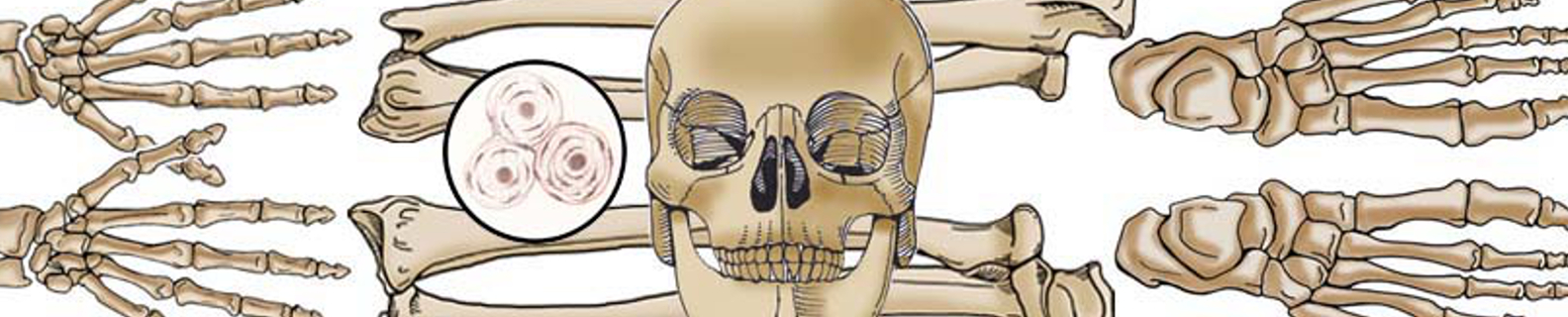
Skeletal system is a union of different tissues (bone tissue, cartilage tissue, and bone marrow) that, developing, give shape to bones, which all together form the skeleton, the scaffolding of the human body. It provides support, defines the shape of the body and protects the internal organs and soft tissues and makes movement possible.
Bones are different in shape depending on the function they perform and they can be divided into long, short and flat bones. They are coated by a membrane called periosteum and they are formed by cells immersed in a hard matter rich in mineral salts and organic substances (ground substance, or extrafibrillar matrix); the bone marrow, where most of the blood cells is generated, is at the most inner part of the bone. On average, the bones that make up the skeleton of an adult are 206. Outwardly, bones show irregularities underpinning the muscles through tendons and ligaments (see articular system).
The fundamental part of the skeleton is the vertebral column (or spine), 33/34 made up of vertebrae (short bones vertically overlapped), inside which there is the spinal cord. If seen frontally the vertebral column has a straight shape, whereas observed from the side it shows curves in which mobile segments (cervical and lumbar, in which the curvature is turned inward) alternate with semi-rigid or rigid ones (dorsal, sacral, and coccygeal, in which the curvature is facing forward). Such curvatures are of fundamental importance for the distribution of the weight of the body that is assured by elastic and shock absorbing disks that separate the vertebrae, the intervertebral discs, which consist of cartilage, and connective tissue.

