
Basketball
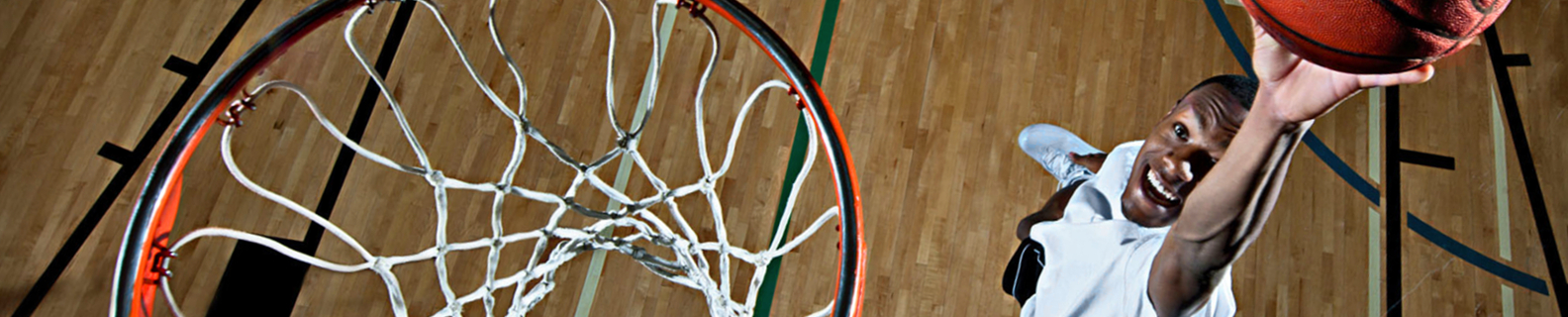
Basketball is a team sport the objective of which is to throw the
ball through the opponents’ basket from top to bottom, throwing from
anywhere in the field, and preventing the opposing team to catch the
ball and do the same.
Baskets can be worth:
- 1 point when players are fouled and get free attempts to shoot the ball (free-throws).
- 2 points when baskets are scored during game play from anywhere inside the three-point line;
- 3 points when baskets are scored from behind the three-point line.
To win a game, the team has to score more points than the other in the allotted game time, that is four periods (quarters) of 10 minutes each (with the stoppage of game, the clock is also stopped). As a game cannot end in a tie, there is one or more extra times of 5 minutes each, until one of the teams wins. The teams are made up of 5 players plus 5 reserves. Teams can make an unlimited number of substitutions.

The referee tosses up the ball in the centre circle between two opposing players, who jump up and try to tip it to a teammate outside the circle (jump ball).
After every made basket, the opposing team must inbound the ball to a teammate on the court from out-of-bounds. After a foul, the player who committed it will then inbound the ball from the sideline at the boundary line nearest the spot of the violation. If the ball goes out-of-bounds, the throw-in should occur at the spot out-of-bounds nearest where the ball crossed the boundary.
Basketball is played with hands and the ball can be passed, thrown, beaten, rolled or dribbled in any direction. It cannot be carried or kicked deliberately.

While a team is in control of the ball, it must attempt a shot for a field goal within 24 seconds. A team has to advance the ball into its front court within 8 seconds. A player cannot hold the ball for more than 5 seconds without dribbling, passing or shooting it. Also, a player shall not remain in the opponents’ restricted area for more than 3 consecutive seconds («three seconds rule»).
There are three types of fouls.
- Personal foul is an illegal personal contact with an opponent. It is committed by a player who shoulders, holds, pushes, strikes or trips in any way of an opponent. The player who commits a foul should signal it by raising one arm. If a player commits more than 4 personal fouls or a more serious personal foul is immediately ejected. After fouls occurred against a player who is not in the act of shooting, the game shall be resumed by an opponent throwing the ball in from the side line out-of bounds. On the contrary, fouls occurring against a player while in the act of shooting result in one free-throw taken if the original shot was made, two free-throws if the original shot was missed, three free-throws if the foul was committed beyond the three-point line. The free-throw is taken from the free-throw line underneath the basket and opponents cannot impede the thrower.
- Technical foul is a violation that results in the other team getting two free-throws.
- Flagrant foul is a serious purposeful personal foul. The fouled team is awarded one or more free-throws and possession of the ball.
As a team foul against the offending player’s team during the current quarter or half and it accumulates 4 fouls in that period enters the penalty situation and puts the other team into the «bonus». If the team committing the foul is in the penalty situation, the fouled player is awarded 2 free-throws. In addition, there are also five types of violations.

- Travelling: it occurs when the player with the ball takes too many steps without dribbling (the «pivot» is not an infringement, that is when the player with the ball spins on one foot and steps with his/her other foot to protect the ball from a defender).
- Dribble: it occurs when a player dribbles with both his hands.
- Double dribble: it occurs when a player stops his/her dribble and then resumes dribbling, instead of passing or shooting the ball;
- Intentional strike with foot or fist: it occurs when a player intentionally kicks or strikes the ball with his/her fist.
- Time: violations of time limits are sanctioned with the loss of the ball.

- Passing: it is the action that allows quick movement of the ball between players of the same team. It also allows to avoid opponents and to play attacking games. A pass consists of an intentional transfer of the ball from one player to another and it is concluded when the latter receives the ball. To make a good reception it is necessary to step towards the ball or to make a forward flexion of the trunk and to keep the arms half flexed. There are many ways to pass the ball.
- Chest pass: during the loading phase, the ball should be at the chest level, with forearms flexed. The ball is gripped on both sides with the thumbs directly behind it. From this position, it is necessary to stretch the legs and arms in the direction of the teammate who is to receive the ball. The throwing phase ends with a backspin and the back of the hands facing one another. It is used for medium and short distances, when there are no obstacles between the players.
- Bounce pass: in this case, the ball takes one bounce before reaching a teammate. This pass is slower than the chest pass, but it is less likely to be intercepted by an opposing player;
- Baseball pass: it is a one-handed pass. The player takes the ball with both hands above his head. In the loading phase, the drive arm faces outwards, the palm is behind the ball and fingers are pointing upwards, while the other hand holds the ball from below. In the throwing phase, the arm stretches with a whipping motion of fingers and wrist. At the same time, body weight shifts from one leg to the other. This is often used to make long passes.
- Overhead pass: in the boosting phase, the ball is brought above the player’s forehead with both hands. Upper limbs give a thrust from above-forward to the ball, with a whipping motion of fingers and the back of the hands facing one another. The ball shall keep a rectilinear trajectory, in order to prevent opponents from intercepting the pass. It is used to make quick passages against shorter opponents.
- Grip: it means how to hold the ball after receiving. The ball is held with two hands, in order to better pass, dribble or shoot the ball. Hands should be on the side of the ball holding it with the fingertips, thumbs should converge inwardly, and arms should be half flexed while elbows are pointing downwards.
- Dribbling: it allows moving to the field while maintaining ball possession. It consists of bouncing the ball on the floor continuously with one hand while walking or running down the court. The dribble ends when the player touches the ball with both hands or holds it with one or two hands. To dribble, the palm of the hand should be over the ball. The wrist should be pushing the ball and the forearm should be moving up and down (boost phase). The ball should be handled with the tips of the fingers that should be spread out across the surface of the ball for a wider, more balanced contact area (cushioning phase). The upper body and legs follow the movements of the arm. Dribbling can be:
- low, that entails keeping the ball low to the floor and in control; the elbow of the dribbling hand is kept close in at the side and the palm of the dribbling hand is kept over the ball; the low dribble is to be used whenever the player is closely guarded;
- high, when the player runs fast and dribbles at the same time, pushing the ball out in front of him/her at waist level and runs after it; his/her hand is not directly over the ball, but behind it, so that the ball can be pushed hard.; the high dribble is to be used when the player is not tightly guarded;
- protected, when a player is closely guarded and has to slow his/her dribble down and almost come to a stop, in order to maintain ball possession.
- Shooting: it is the final part of an action aiming at scoring. A player can shoot from any position, while running or standing still. A free-throw is a shot made standing still. In the first phase, the ball is thrown upwards, so that it will descend to enter the basket. There are many types of shooting.
- Overhead shot: the player holds the ball over his/her head with both hands. His/her body weight is slightly shifted to the side of the throwing arm and the ball rests on his/her hand. His/her upper and lower limbs are flexed. If the player shoots right-handed, his/her right foot should be slightly forward, and vice versa. Ankles flexion provides the initial thrust for release of the ball, whereas the final phase is provided by a whip-like motion of the wrist imparting a curvilinear motion on the ball. The ball should always be aligned with the imaginary line going from the back of the hand, to the elbow, the knee and the foot. If the opponent is trying to block the ball, the shooting player should be jumping, propelling the ball in an arc into the basket (jump shot).
- Layup: the player holds the ball with two hands. If he/she is right-handed, he/she takes possession of the ball before touching ground with the right foot, and then he/she steps forward with the left foot taking a full stride to push off the court. The right leg should be bent and the arms should be aiming at the basket. The left arm stretches and gives the thrust to the ball. Lefties shall perform the same movements with opposite arms and legs.
- Free-throw: a time out is called and the shooter takes his/her place behind the free-throw line. In addition to the shooter, 3 attackers and 2 defenders, placed along the restricted area, wait for a rebound in case the shot is missed. Lower limbs should be as wide as shoulders, legs should be half flexed, and the shooting arm extends forward towards the hoop, with an open hand. During the thrust phase, fingers turn down along with the wrist in a whip-like motion.
- Rebound (offensive or defensive): the action starts with the ball bouncing on the backboard. Then, the defending team gains possession of the ball and starts a new action from the backline.


- Playmaker (point guard): he/she organizes the team’s offence by controlling the ball and making sure that it gets to the right player at the right time.
- Shooting guard: he/she creates a high volume of shots on offence, mainly long-ranged, and he/she guards the opponent’s best perimeter player on defence.
- Small forward: he/she is primarily responsible for scoring points via cuts to the basket, as well as for dribble penetration; on defence seeks rebounds and steals, but sometimes he/she plays more.
- Power forward: he/she plays offensively often with their back to the basket; on defence, he/she plays under the basket (in a zone defence) or against the opposing power forward (in man-to-man defence).
- Centre: he/she uses height and size to score (on offence), to protect the basket closely (on defence), or to rebound.

