
Five-a-side football

Five-a-side football is a team sport aiming at scoring as many goals as possible by kicking the ball in the opponents’ goal and passing the goal line between the goal posts and under the crossbar. The team that scores the most goals is declared the winner; the match may end in a draw. Each team shall field a maximum of 5 and a minimum of 3 players on field, including the goalkeeper. The maximum number of reserve players shall be of 7. During the match it is possible to make an unlimited number of substitutions, without restrictions on restarts. A match consists of two halves and each half is 20 minutes long. Between the two halves, there is an interval, which is not more than 15 minutes long. Both teams can take a minute of time out for each half.

The kick-off is taken from the centre spot and all players must be in their own half of the field of play, remaining at least 3 m from the ball. The player who has first kicked the ball may not touch it again until it has been touched by another player. A goal may be scored directly from a kick-off.
The ball is out of play when it has wholly crossed the goal line whether on the ground or in the air, or when it hits the ceiling and when play has been stopped by the referee. The throw-in is kicked from the side of the field. The player performing a throw-in must have both feet on the touchline and the ball must be stationary prior to being kicked. A goal may not be scored from a throw-in and the player taking the kick cannot touch the ball twice in a row.
If the last person to touch the ball is from the attacking team and the ball goes out of the field of play by crossing the goal line, either on the ground or in the air, a goal kick is awarded to the defending team. The ball is in play when it is kicked directly beyond the penalty area and opposing players can enter the penalty area.
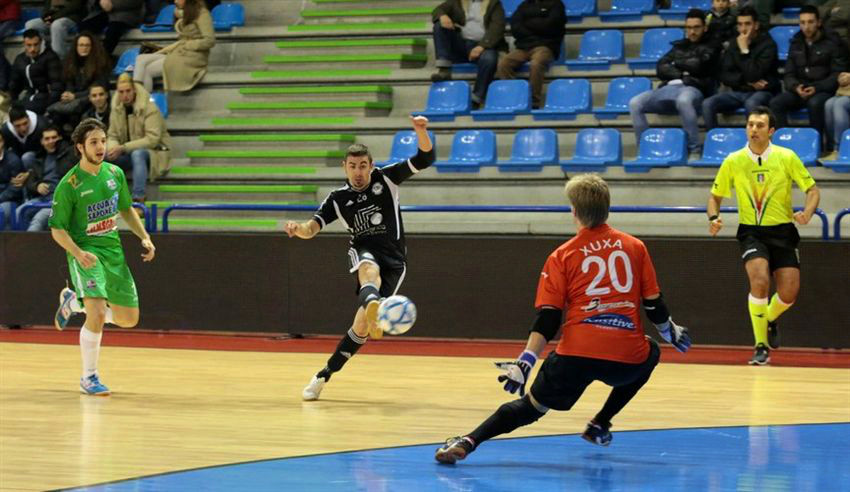
It is possible to pass the ball to the goalkeeper when the ball has crossed the halfway line. The goalkeeper intervenes with his/her feet and he/she is considered like any other player. On the contrary, when the goalkeeper receives the ball from a teammate, right after having put it back in play, an indirect free kick is awarded.
A corner kick is awarded when the ball leaves the field of play by crossing the goal line, having been last touched by a defending player. The kick is taken from the intersection of the goal line and touchline and a goal may be scored directly from a corner kick.
A direct free kick is awarded when a player commits a deliberate foul outside of their own penalty area (e.g. kicking or attempting to kick a player, charging at an opponent player, pushing an opponent player, tripping or attempting to trip an opponent player, handling the ball with a purpose, holding a player.). This kick should always be taken at the spot where the offence took place, within 4 seconds. A goal may be scored directly from a direct free kick. However, if the offence was committed by the defending team within their penalty area, the kick becomes a penalty kick.
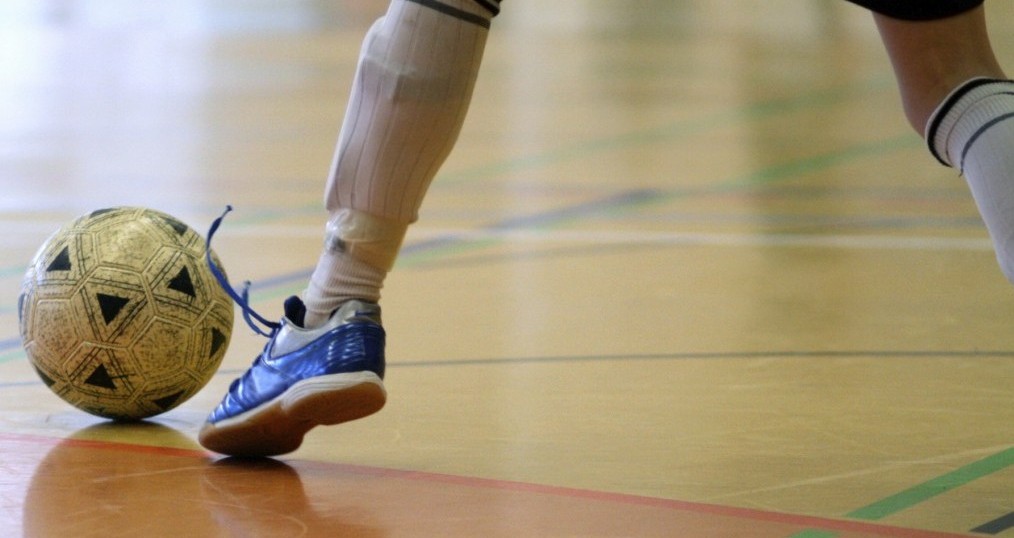
An indirect free kick is awarded when the player plays in a dangerous way, if he/she obstructs his/her opponent, when a player tackles the goalkeeper in his/her penalty area, when he/she touches the ball with his/her hands after his/her teammate has passed it to him/her or holds the ball with his/her hand for more than 4 seconds before releasing it. A goal may not be scored directly from an indirect free kick. Opponents must remain 5 m from the ball until the ball is in play.
Once a team has accumulated 5 fouls during a half, each additional foul is punished by giving the other team a penalty/free kick, which is taken from the penalty mark at 12 m out from the goalmouth. All other players should be positioned outside the penalty area, but within the field of play and at least 5 m from and behind the penalty mark until the ball is kicked.

- Ball control: the player controls the ball kicking it in varying intensity, depending on the circumstances. A kicker should wait until the ball is at his/her supporting leg level, in order to hit the ball his/her best. The player should bend forward at the waist, in order to maintain his/her balance, and he/she should control the ball and look at what is happening on the field. The kicking speed should be rationed carefully as well. Ball may be controlled as follows: with the inside of the foot, with instep, with the outside and the sole of the foot.
- The dribbling is the ability to carry the ball past an opponent while being in control and avoiding defenders’ attempts to prevent this occurring. Dribblers shall not lose dribbling speed and if necessary, they shall use feints to disorient the opponent.
- Ball reception (or stop): it allows cushioning the speed of the ball, which is accompanied to the ground and controlled more easily. It can be performed with the plant, the outside and the inside of the foot. In order to perform it correctly, you need to understand the direction from which the ball arrives and according to this it is necessary to change the position of your body. The body part that is used to stop the ball should be relaxed as much as possible and it should retreat upon contact, following the impact of the ball.
-
Passing the ball: it builds the attack strategy and sets the team action strategy. Passing allows the
ball to be easily and quickly distributed to teammates. It may be performed at ground level, at half-height and upwards
and with several techniques.
- With the inside of the foot: it is used for passes with the support leg next to the ball facing the direction of passage; the player strikes with the inside of the foot (at an angle of 90° approximately) and the striking leg moves accompanying the ball.
- With the instep: it is used in distant half-height/high passages; the supporting leg is next or behind the ball and the body is kept slightly backwards; the ball is struck from below, with the inside part of the instep.
- With the inside of the foot-instep.
- With the outside of the foot: the ball is hit with the outer part of the instep; this pass is often used after a feint on the opponent.
- Shot: the purpose of shooting is to get the ball past the goal line. The ball is kicked as in the passage, but it is hit with greater power. Sometimes, the kick with toe it is also used, as the ball moves more quickly, but inaccurately.
- Header: with the head you may receive (the ball is stopped with a backward movement, which aims at cushioning its speed), pass and throw the ball. To perform a header you need to have good coordination and muscles. In order to send the ball to the right you shall keep your right leg forward, whereas to send it left your upper body shall be oriented in the direction in which you want to send the ball. Usually, the header is performed while jumping and the ball is hit at its highest elevation point.
- Save: this is the last chance to prevent the opponent team from scoring. The goalkeeper moves sideways very quickly so that his/her body is always on the trajectory of the ball and he/she is able to block it to prevent the opponents from drive it back. To intercept the ball in fast and angled shots, when it is not possible to block the ball, the goalkeeper should deflect the ball extending an arm or a leg. The goalkeeper should always be prepared; he/she should remain on his/her toes to no more than one metre from the goal line, by moving from one goalpost to the other and tracing a semi-circle.
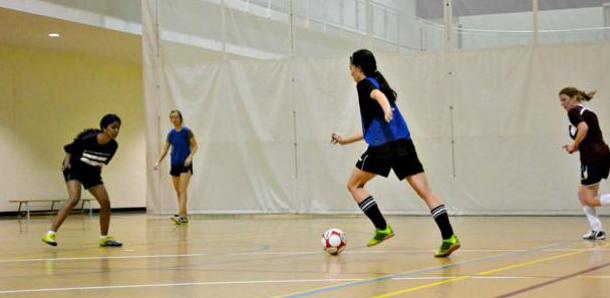
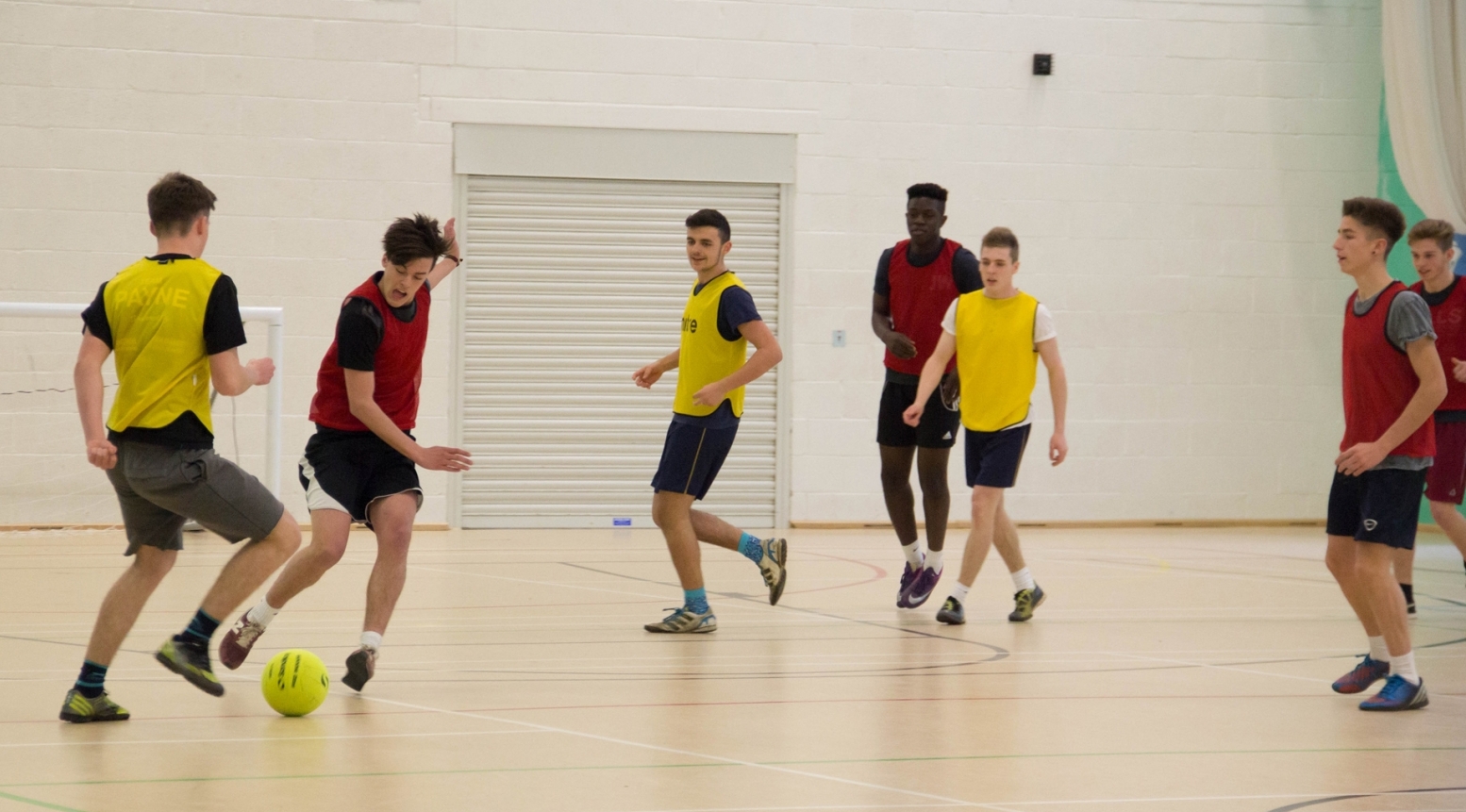

- Goalkeeper: he/she has quick reflexes; he/she intervenes at close range against fast and powerful shots. Acrobatic skills and strong personality are essential.
- Wing (right and left): he/she is agile and quick and he/she should be able to kick with both feet. He/she should also have a good ability to create and occupy free spaces.
- Centre midfield: he/she is the strongest defender; he/she shows excellent recovery and anticipation abilities, as well as ball interception and playmaking skills.
- Pivot: he/she is agile and quick, as well as good at kicking and protecting the ball. He/she also has to be able to flank play; hence he/she should have ability to turn around from side to side to open spaces that teammates can exploit.

